For commerce faculty
The teaching assistant you were never given.
Give PlaPer your syllabus and the book you teach from. It plans every class out of your own pages, then fills them with activities the room plays rather than sits through. Built for commerce teaching first.
Free while the beta runs. Joining is free for the room, permanently.
Methods: FIFO, weighted average
60 min, read from your textbook, pages 4 to 6
- 8mOpen with the worked example from the chapter: opening 100 units at Rs 20, purchase 100 at Rs 26, sell 150.
- 12mNow work through weighted average on the same example.
- 15mTimed rounds of questions on FIFO and weighted average calculations.
- 10mAddress the common error directly: the lower of cost and NRV test applies item by item.
Where it usually goes wrong. Students divide total cost by opening units only, forgetting to include purchases in the denominator.
Printed as it came back, from a textbook uploaded to the app. Each step is cut to its first sentence and nothing else is edited.
The parts that do the work.
Next up
- Methods: FIFO, weighted average
- Capital and revenue expenditure
- Goodwill valuation
- Written down value method
It knows what is next
Your syllabus becomes a course it can order. The topic you have not taught moves to the top.
Ask
One line, not a brief
Name the topic and the minutes. It finds the pages in the book you uploaded and works from those.
On the board
18
phones in, no accounts
A code on the screen
Nobody installs anything and nobody makes an account. Nothing is collected from the room.
In the library
Some run on thirty phones. Some run on the board with no devices at all. Some print, and work the week the wifi does not.
Written for this subject
Judgement rounds, printed card sorts and spreadsheet tasks, all for commerce topics rather than general knowledge.
Monday, 60 minutes
- 8mOpen with the chapter’s own worked example
- 12mWeighted average on the same figures
- 15mTimed rounds on both methods
- 10mThe error they always make
Shaped like an hour
Not a lecture script. The running order, the minutes, and where the room gets stuck.
You make one entry.
It makes the matching one. Your side of this page is four words long, which is the whole point of having an assistant.
The first two happen once a term. The rest are a week.
- Once
Upload your syllabus
Your course appears: units, chapters, and the topics under each one. It is your copy, so rename, reorder and skip whatever you want.
Upload the textbook
Every chapter matched to the pages it runs from. A 400 page book is read once and remembered, so it costs you a minute and then never again.
- Each class
Name the topic
A plan built out of those exact pages: the running order, the minutes, the book’s own worked example, and the mistake the room usually makes.
Ask for questions
Twenty written from the chapter you ticked. Not from a bank somebody else wrote, and not from the internet.
- In the room
Put the code on the screen
Phones in, scored live, forty minutes. Or print it and hand it round, or run it off the board with no devices in the room at all.
- After
Walk out
A report on what they got wrong, ranked. Written the moment the session ends, and never rewritten afterwards.
What you keep
The course, every plan, and a record of what each class found hard. Exportable, and still yours if you leave.
Then the room stops being an audience.
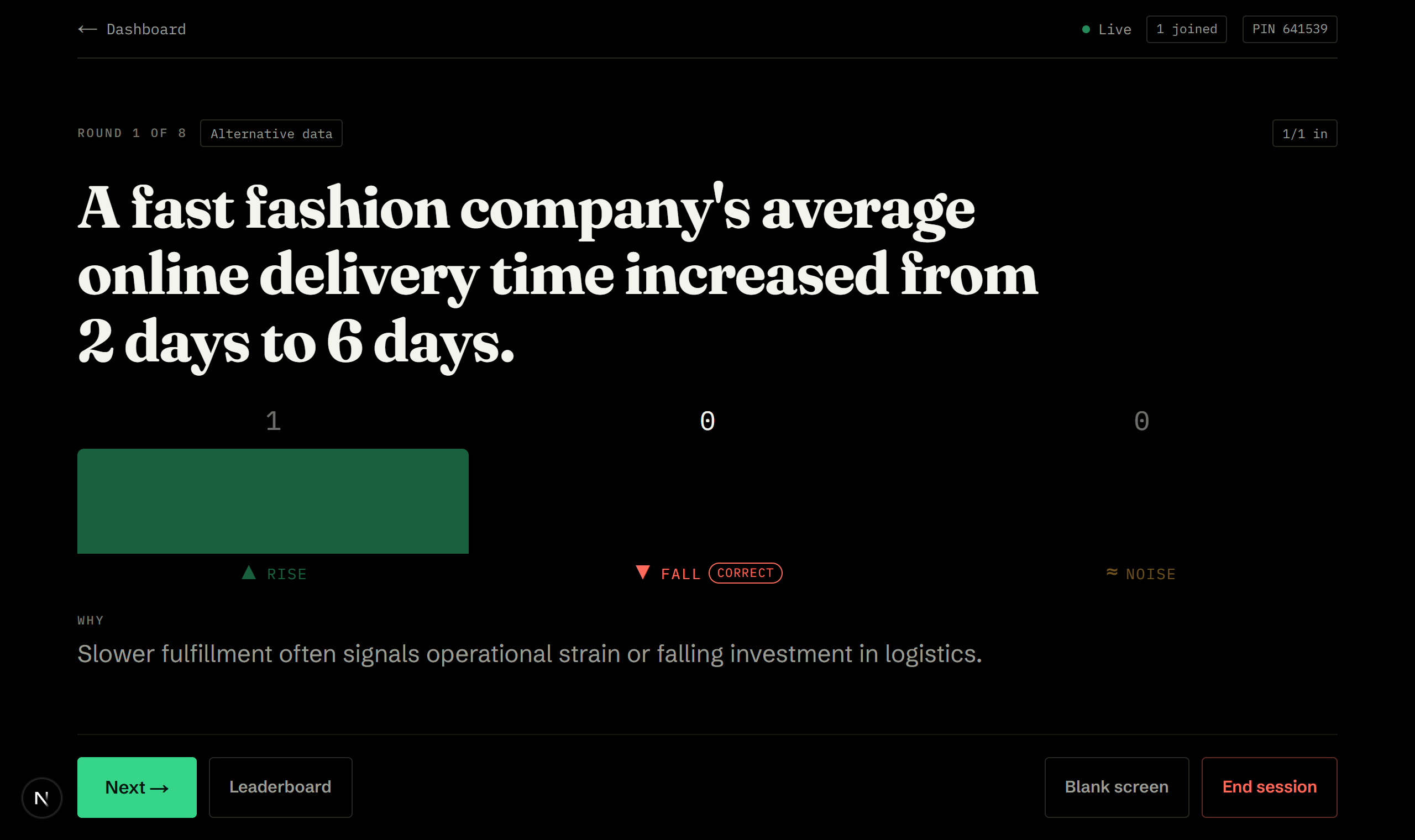
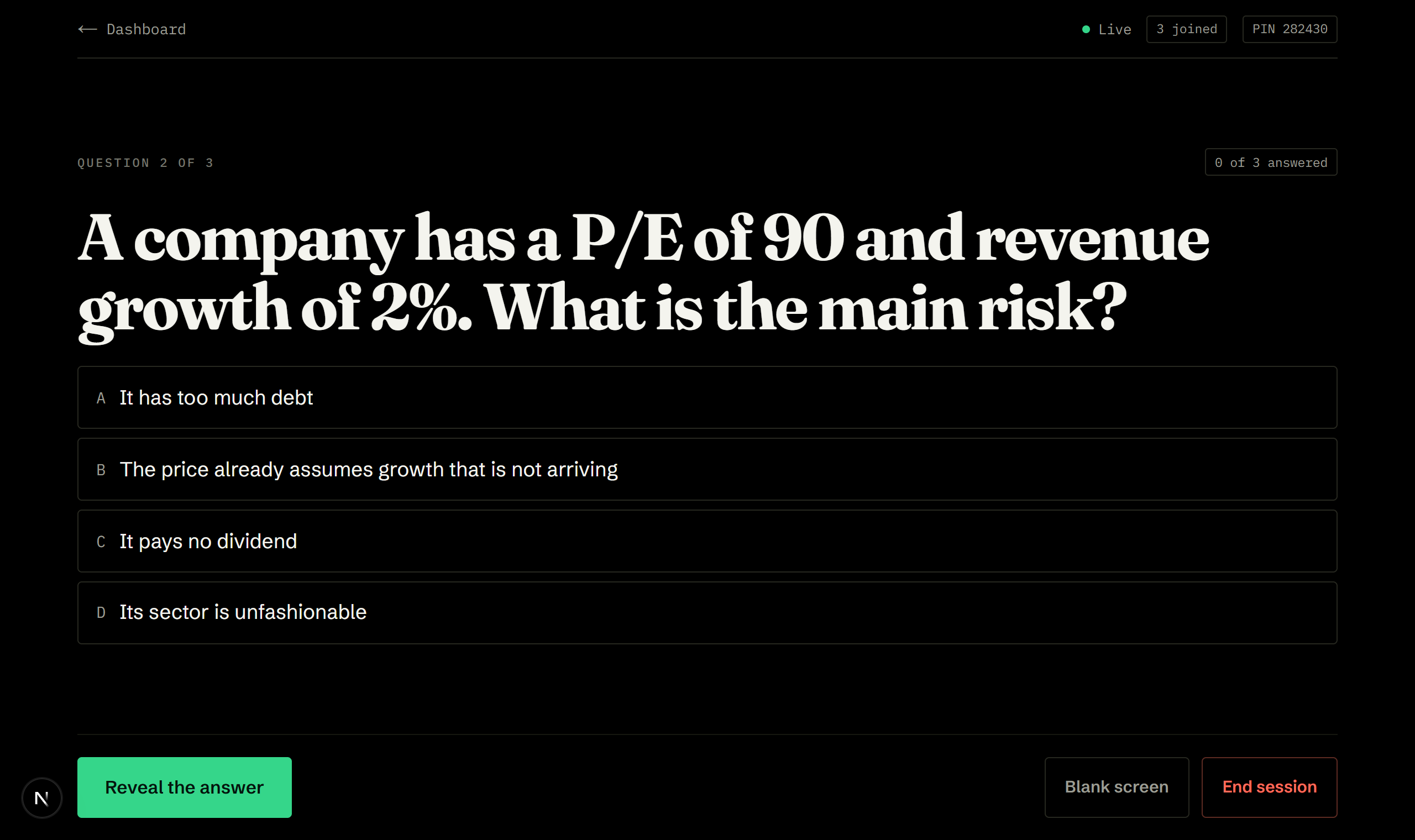
10 activities, five minutes to an hour. Faster correct answers are worth more, so the standings keep moving, and four winners get named instead of one. They are often different people.
On the way out
1 CSV
What the room missed, ranked, written the moment the session ends and never rewritten afterwards.
Commerce first, and on purpose.
A wrong figure in front of a CA class is not recoverable, so the content is written and checked for the subjects we can actually check.
The syllabus map ships with CA, CMA and CFA already in it, and nothing here implies any of those bodies endorses us. The engine underneath does not care what the subject is, so the library will widen. Today it is written for commerce, and if you teach something else it is honest to say you are early.
- Financial accounting
- Debit and credit rules, journal entries, capital against revenue, inventory valuation, final accounts.
- Cost and management
- Cost behaviour, break even, cash budgets and working capital, with answer keys worked out by a calculator rather than typed.
- Taxation
- Allowable business expenditure. Held as a draft until a named person signs it off, because the Act changes and being wrong here is not recoverable.
- Data and markets
- Reading a figure and deciding whether it means anything, and a market simulation that runs on real Indian companies.
One class now. The whole term next.
Live now
A plan from your own book
Upload the syllabus and the chapter. It finds the pages, writes the running order, and puts an activity in it.
Live now
Activities that need no phones
Printed kits to cut up, and spreadsheet tasks for a computer lab, for the weeks when the wifi is out or the phones are in a box at the door.
Next
The whole term, laid out
Your timetable and your syllabus become a week by week roadmap, with the hours counted and revision held back at the end.
The first two are live today. This page will say so when the third arrives.
Upload one chapter and read what comes back.
It takes about five minutes. Nothing goes in front of a room until you say so.